
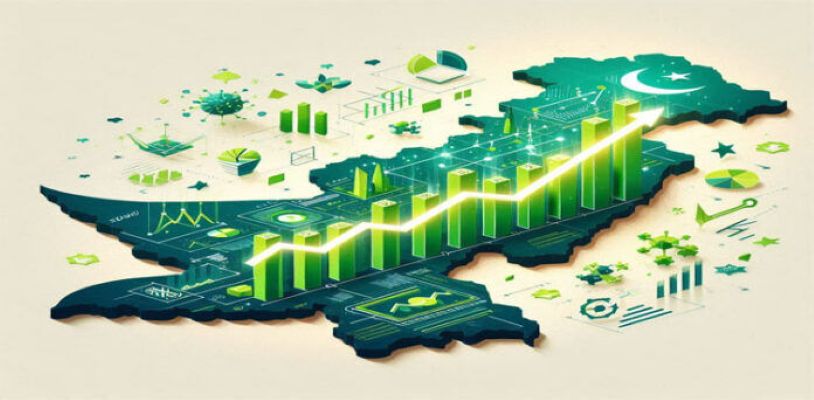
The Pakistan Economic Growth Target FY2026-27 has been set at 4%, while the government aims to keep inflation at 8.2% during the next fiscal year. The targets were approved by the Annual Plan Coordination Committee (APCC) and will now be presented to the National Economic Council (NEC) for final approval.
The decision comes after Pakistan recorded economic growth of 3.7% in FY2025-26, falling short of the official target of 4.2%. Despite missing the goal, the economy showed improvement compared to the previous fiscal year’s growth rate of 3.2%, reflecting gradual recovery across key sectors.
Under the Pakistan Economic Growth Target FY2026-27, commodity-producing sectors are expected to expand by 3.9%. Agriculture is projected to grow by 3.8%, supported by improvements in major crops, cotton ginning, and livestock production. Policymakers view the agriculture sector as a key contributor to overall economic performance.
The industrial sector is targeted to achieve 4% growth, driven largely by a recovery in large-scale manufacturing, which is expected to rise by 4.5%. Growth in mining, construction, energy, and related industries is also expected to support broader industrial expansion during the fiscal year.
The services sector is projected to grow by 4.2%, with strong contributions from wholesale and retail trade, transportation, communications, financial services, and information technology. The information and communication sector is expected to remain one of the fastest-growing segments of the economy.
The government also aims to increase national savings to 14.3% of GDP and raise overall investment to 15% of GDP. Private investment is expected to increase significantly, while inflation is forecast at 8.2% amid efforts to maintain fiscal discipline and macroeconomic stability.
The Pakistan Economic Growth Target FY2026-27 includes plans to generate around two million new jobs through higher investment and economic activity. Authorities expect employment opportunities to expand across agriculture, industry, and services, supporting broader economic inclusion despite challenges such as external sector pressures and global economic uncertainty.