
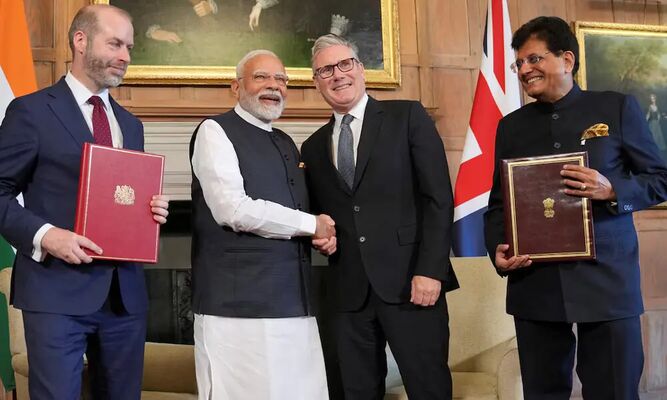
The India-UK trade pact officially came into force on Wednesday, marking a significant milestone in economic relations between the two countries. The agreement reduces tariffs on thousands of products, expands market access for services, and is expected to strengthen trade, investment, and business cooperation between India and the United Kingdom.
The Comprehensive Economic and Trade Agreement provides Indian exporters with immediate duty-free access to most British tariff lines. Labour-intensive industries such as textiles, leather, footwear, marine products, processed foods, and gems and jewellery are expected to benefit the most from lower trade barriers and improved market access.
For Britain, the agreement opens greater access to one of the world’s fastest-growing major economies. Tariff reductions on automobiles will be introduced gradually through quotas, while new opportunities have also been created in financial services, education, insurance, government procurement, and professional services.
India’s Commerce and Industry Minister Piyush Goyal said the agreement would create new opportunities for trade, investment, and innovation. He added that the deal is expected to support Indian businesses while strengthening long-term economic cooperation between both countries.
According to India’s Ministry of Commerce, India exported goods worth $13.44 billion to Britain and imported $11.68 billion during the 2025-26 financial year. Bilateral services trade reached $35.44 billion in 2024, with India recording a services trade surplus of nearly $7.9 billion.
The India-UK trade pact also broadens access across 137 services sub-sectors, including information technology, telecommunications, finance, education, and business services. It simplifies temporary entry procedures for investors, business visitors, professionals, and service providers, making cross-border business operations more efficient.
Another key feature of the agreement is the Double Contribution Convention, which exempts eligible Indian professionals and employers from paying Britain’s National Insurance contributions for assignments lasting up to five years. Officials believe the agreement will further boost bilateral trade by creating long-term opportunities for exporters, businesses, investors, and skilled professionals in both countries.