
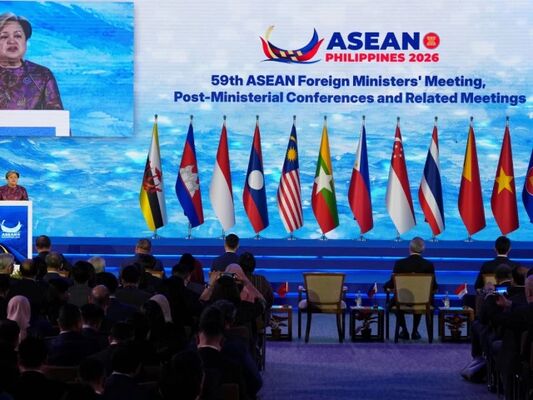
The ASEAN Foreign Ministers’ Meeting officially opened in Manila on Tuesday, with member states calling for greater unity as geopolitical tensions, maritime disputes and global uncertainty continue to challenge the region. The gathering brings together Southeast Asian diplomats to discuss key political, economic and security issues.
Opening the 59th ASEAN Foreign Ministers’ Meeting, Philippine Foreign Affairs Secretary Ma. Theresa P. Lazaro urged member states to respond to global challenges through cooperation and practical solutions. She said the region faces increasing uncertainty and stressed the need for collective action.
During her address, Lazaro highlighted the Philippines’ 2026 ASEAN chairmanship theme, “Navigating Our Future, Together,” saying member states must work together to shape the region’s future rather than react to external events. She also emphasized dialogue and consensus in addressing shared challenges.
Lazaro described the Treaty of Amity and Cooperation (TAC), which marks its 50th anniversary this year, as the foundation of ASEAN’s regional stability. She said its principles of sovereignty, non-interference and peaceful dispute resolution remain central to the organization’s cooperation.
The ASEAN Foreign Ministers’ Meeting is expected to review progress under the bloc’s political-security, economic and socio-cultural pillars. Ministers will prepare recommendations for consideration at the ASEAN Summit scheduled for November.
Regional security will dominate discussions throughout the week. Key agenda items include efforts to revive ASEAN’s peace initiative in Myanmar, negotiations with China on the South China Sea Code of Conduct, and the impact of global conflicts on energy supplies and international trade.
The meetings will continue through July 24 and include sessions with ASEAN dialogue partners, the ASEAN Plus Three, the East Asia Summit and the ASEAN Regional Forum. Representatives from the United States, China, Russia, Japan, India and the European Union are expected to participate in discussions on regional and global security.