

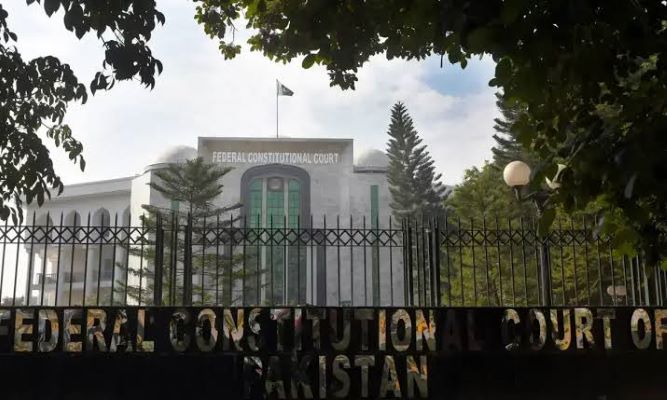
The Federal Constitutional Court (FCC) has sought records of all prisoners’ private treatment cases pending before the Supreme Court and high courts. The order came during a hearing on a petition seeking private hospital facilities for three prisoners. The petition referred to facilities previously provided to PTI founder Imran Khan.
A three-member bench led by Chief Justice Aminuddin Khan directed relevant courts to submit records of similar cases. The FCC also asked the Supreme Court to provide records related to contempt proceedings involving Imran Khan. It sought details of his hospital transfer request and a review petition concerning his medical treatment.
The Attorney General for Pakistan told the court that Article 175E, sub-clause 5, of the Constitution gives the FCC authority to call for records from any court. He said this power applies when a case involves questions concerning constitutional interpretation. The court is examining whether this authority applies to the matters before it.
Chief Justice Aminuddin Khan observed that the petitioner argued that constitutional and legal provisions should apply equally to rich and poor people. The observation came as the bench considered the broader legal questions surrounding private medical treatment for prisoners and the equal application of legal rights.
Justice Ali Baqar Najafi asked whether the government had challenged the matter before the Supreme Court. The attorney general replied that the Supreme Court had issued an order without first serving notice on the government. He said Additional Attorney General Amir Rehman had raised an objection before the Supreme Court.
Justice Najafi also questioned whether the Supreme Court should have first examined whether the petition was maintainable. The attorney general agreed that maintainability was the issue. He further argued that constitutional interpretation now falls within the authority of the Federal Constitutional Court.
Justice Aamer Farooq noted that the Supreme Court case was criminal in nature, while the FCC matter had arisen from an Islamabad High Court judgment. He said the Supreme Court order was still interim. Justice Najafi said the central issue was jurisdiction, including which forum has authority over cases involving constitutional interpretation and fundamental rights.