
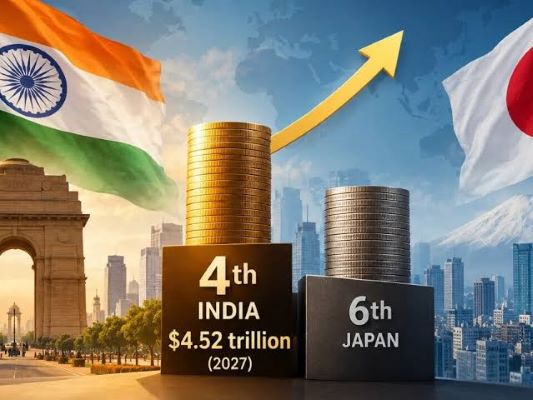
India is expected to become the world’s fourth-largest economy in 2027, overtaking Japan, according to projections by the International Monetary Fund (IMF). The forecast highlights the different economic paths of the two Asian countries, with India maintaining stronger growth while Japan faces several long-term challenges.
The IMF projects that India’s gross domestic product (GDP) will reach $4.52 trillion in 2027. Japan is expected to lose its current fourth position and fall to sixth place, also behind the United Kingdom. The United States is projected to remain the world’s largest economy, followed by China and Germany.
India’s economic performance has remained strong despite global uncertainty and financial pressures. The IMF recently raised its forecast for India’s economic growth in 2026 to 7 per cent. This outlook reflects the country’s growth momentum and its ability to manage external economic challenges.
IMF Asia Director Krishna Srinivasan said India entered the current energy price shock with strong economic fundamentals. He highlighted the country’s solid growth, careful fiscal management and substantial foreign exchange reserves. These factors have helped India respond effectively to higher energy prices linked to the US-Israel war on Iran.
Japan, meanwhile, faces slower economic growth due to structural challenges, including an ageing population. The IMF expects Japan’s economy to grow by just 0.7 per cent in 2026. Higher energy costs and rising consumer prices have added pressure, prompting the Bank of Japan to raise interest rates to their highest level in three decades.
IMF Growth Forecast 2026:
🇺🇸 US: 2.3%
🇩🇪 Germany: 1.3%
🇫🇷 France: 0.4%
🇮🇹 Italy: 0.8%
🇪🇸 Spain: 2.5%
🇬🇧 UK: 1.3%
🇯🇵 Japan:0.7%
🇨🇦 Canada: 1.1%
🇨🇳 China:4.5%
🇮🇳 India: 7.0%
🇷🇺 Russia:0.9%
🇧🇷 Brazil: 2.2%
🇲🇽 Mexico: 1.5%
🇸🇦 Saudi Arabia: -3.3%
🇳🇬 Nigeria: 4.2%
🇿🇦 South Africa: 1.0%
https://t.co/yoil3EB47M— IMF (@IMFNews) October 13, 2026
The weaker Japanese yen has also increased the cost of imported goods. The currency reached its lowest level against the US dollar in 40 years over the summer, adding to inflationary pressures. Although Japan has benefited from increased investment in artificial intelligence, Srinivasan said its gains have been smaller than those of some regional economies.
Financial markets also reflected concerns about Japan’s economic outlook. Tokyo’s benchmark Nikkei index fell nearly 5 per cent on Thursday as technology shares declined amid doubts about the profitability of artificial intelligence investments. The IMF’s projections suggest that India could strengthen its position among the world’s largest economies, while Japan continues to face growth and demographic pressures.