
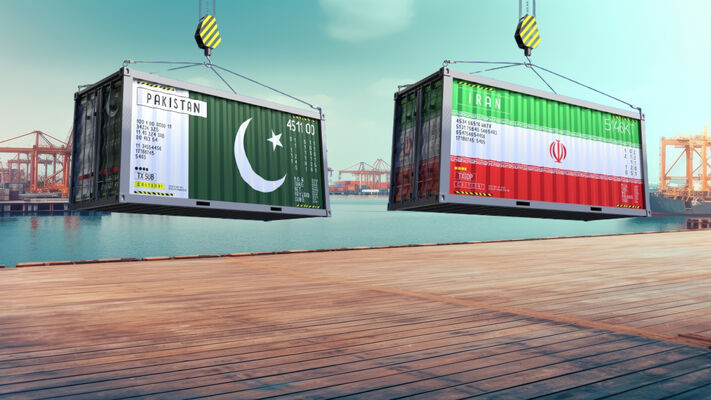
Pakistan-Iran trade has the potential to grow to $10 billion annually within the next three to five years if both countries improve banking channels, simplify cross-border trade procedures and strengthen industrial partnerships, the Federation of Pakistan Chambers of Commerce and Industry (FPCCI) said on Saturday.
FPCCI President Atif Ikram Sheikh said the current volume of bilateral trade remains well below its true potential despite the strong historical and economic ties between the two neighboring countries. He made the remarks while welcoming a high-level business delegation from Iran’s Arak Province to the FPCCI.
According to the FPCCI, bilateral trade between Pakistan and Iran stood at approximately $2.8 billion during the 2023-24 fiscal year. The figure included $684 million in Pakistani exports to Iran and $2.1 billion in imports from Iran.
Highlighting the future outlook for Pakistan-Iran trade, Atif Ikram Sheikh said the private sectors of both countries should move beyond conventional trading and develop long-term industrial partnerships. He added that the two economies possess complementary strengths that could significantly expand bilateral commerce.
The Iranian delegation was led by Naser Beigi, President of the Arak Chamber of Commerce, Industries, Mines and Agriculture. He said Arak Province offers expertise in heavy machinery, engineering equipment, automotive parts, mining solutions and agricultural technology, creating opportunities for cooperation with Pakistan’s industrial sector.
Iran’s Commercial Attaché in Pakistan, Murad Nemati, said the ongoing business dialogue aims to promote investment and joint ventures in sectors including agriculture, food processing, petrochemicals, mining, engineering, household appliances and renewable energy.
FPCCI Senior Vice President Saquib Fayyaz Magoon stressed that stronger Pakistan-Iran trade would require simplified trade regulations, formal banking and payment mechanisms, and improved transport and logistics infrastructure. He said the FPCCI would continue supporting businesses from both countries seeking to establish formal commercial partnerships.