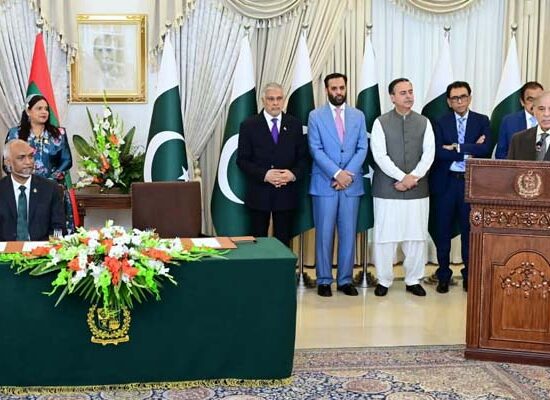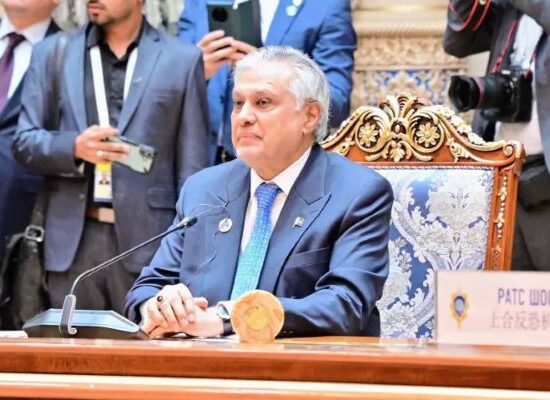

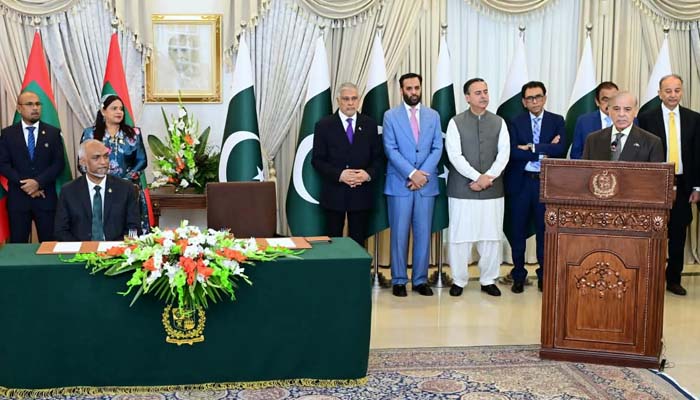
Islamabad: Prime Minister Shehbaz Sharif has declared that Pakistan’s water is a red line and warned that any attempt to stop the country’s water supply would be considered an act of war. He made the remarks during a ceremony marking the exchange of memorandums of understanding between Pakistan and the Maldives.
The ceremony was attended by Prime Minister Shehbaz Sharif and Maldivian President Dr Mohamed Muizzu. The two sides discussed strengthening bilateral cooperation in several areas, including trade, economic relations, defence, education, and healthcare.
Speaking at the event, Shehbaz Sharif said relations between Pakistan and the Maldives had grown stronger across various sectors. He highlighted the presence of a large number of Maldivian students studying at Pakistani educational institutions and praised Pakistani doctors and healthcare workers serving people in the Maldives.
The prime minister added that Pakistan would be pleased to meet more of the Maldives’ needs as a brotherly country. He emphasized the importance of expanding cooperation and building stronger economic and institutional links between the two nations.
Shehbaz Sharif also reiterated Pakistan’s support for the Palestinian cause, saying the country would continue to uphold its principled position in favour of an independent and sovereign Palestinian state. He noted that the Maldives also fully supports the Palestinian issue.
Addressing water security, the prime minister described India’s unilateral suspension of the Indus Waters Treaty as unacceptable. He stressed that all countries must honour internationally recognised agreements and reiterated that any attempt to obstruct Pakistan’s water supply would cross a red line.
Maldivian President Dr Mohamed Muizzu said the two countries had maintained six decades of diplomatic relations based on mutual cooperation. He expressed a commitment to expanding collaboration in education, healthcare, trade, and economic development. He also highlighted the potential of the Pakistan-Maldives Business Forum, youth exchange programmes, artificial intelligence, and digitalisation to create new opportunities for bilateral engagement.