

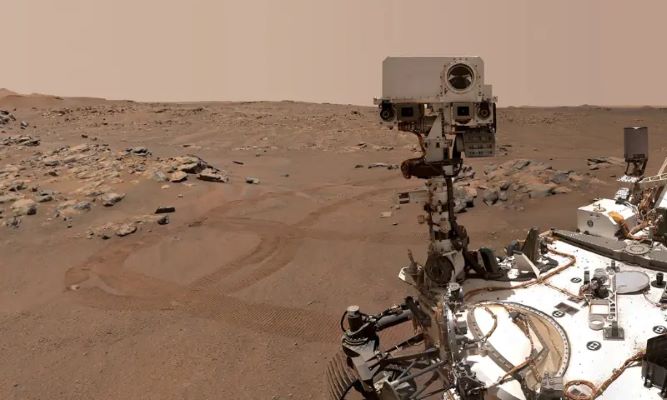
NASA’s Perseverance rover has set a new record for driving on the surface of a world beyond Earth. The robotic vehicle has travelled 28.1 miles, or 45.2 kilometres, since landing on Mars in 2021, the US space agency announced on Tuesday.
The car-sized, six-wheeled rover reached the milestone about five and a half years into its mission. Its primary scientific goal is to investigate whether ancient Mars once had environmental conditions suitable for microbial life. The mission is also examining some of the oldest geological landscapes in the solar system.
Perseverance has surpassed the previous record held by NASA’s Opportunity rover, which travelled approximately 28.06 miles, or 45 kilometres, on Mars between 2004 and 2018. Both rovers also exceeded the driving distances achieved by lunar exploration vehicles. NASA officials said Perseverance’s engineering systems remain in excellent condition.
The rover has concentrated its exploration on Jezero Crater in Mars’ northern hemisphere. Scientists believe the region once contained a lake and received water from ancient river channels billions of years ago. Perseverance reached the latest milestone while travelling towards an area called Idubi through terrain near the crater’s western rim, known as Lac de Charmes.
NASA has credited the rover’s autonomous navigation system, AutoNav, for helping it cover long distances. Project manager Steven Lee said around 90 per cent of its drives are completed autonomously. The system uses stereo images to create three-dimensional maps and select safer routes, while a specialised computer processes images rapidly during movement.
One of Perseverance’s most significant scientific findings is a potential biosignature announced in 2025. The possible indicator of ancient microbial life was identified in reddish rock estimated to be between 3.2 billion and 3.8 billion years old. Scientists are investigating the geological context of the discovery, but it has not established that life existed on Mars.
NASA has extended Perseverance’s mission to explore the crater rim until approximately the end of 2028. Its mobility systems are also being tested for longer journeys, potentially reaching 100 kilometres or more. According to NASA, the rover’s power system continues to perform as expected, with several years of useful energy remaining.