

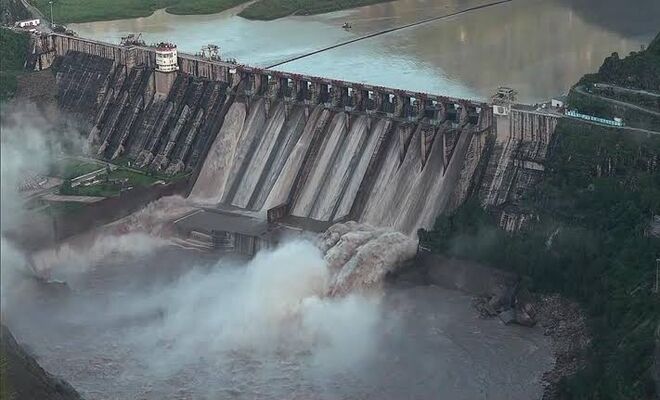
The Indus Waters Treaty has become a major concern after Water and Power Development Authority (WAPDA) Chairman Lt Gen (r) Muhammad Saeed warned that India’s decision to suspend the agreement poses a long-term threat to Pakistan’s water, food, energy and economic security. He said the move also risks the stability of the Indus Basin Irrigation System, which supports millions of people and the country’s agriculture.
Writing in a local newspaper, Lt Gen (r) Saeed said the Indus Waters Treaty has remained one of the world’s most successful and internationally recognised water-sharing agreements for more than 65 years. He noted that the treaty has provided certainty in river flows, allowing Pakistan to build an extensive irrigation network and strengthen its water resources.
According to the WAPDA chairman, the Indus Basin Irrigation System is the world’s largest contiguous irrigation network. It includes three major reservoirs, six barrages, 12 inter-river link canals and an extensive canal distribution system. The network irrigates nearly 35 million acres of farmland and supports more than 90% of Pakistan’s food production while contributing significantly to hydropower generation and the national economy.
Saeed said India’s decision in May 2025 to place the Indus Waters Treaty in abeyance has created uncertainty over Pakistan’s future water supplies. He described the move as unilateral and said it is widely viewed as inconsistent with international treaty obligations and the principles of cooperation governing shared rivers.
He also expressed concern over India’s accelerated work on upstream infrastructure projects, including the proposed expansion of the Ranbir Canal and the Chenab-Beas Link Tunnel. According to him, the combined effect of these projects could influence the quantity, timing and predictability of river flows entering Pakistan, creating serious long-term challenges.
The WAPDA chairman further said India has stopped sharing hydrological data for the western rivers with Pakistan, despite treaty obligations. He warned that the lack of timely river flow information weakens flood forecasting, emergency preparedness and water management, increasing risks to agriculture, infrastructure and public safety.
Highlighting the strategic importance of the Chenab River, Saeed said Pakistan’s concerns go beyond individual dams or projects. He stressed that maintaining reliable and predictable river flows under the Indus Waters Treaty is essential for protecting Pakistan’s irrigation system, food security, water resources and long-term economic stability.