

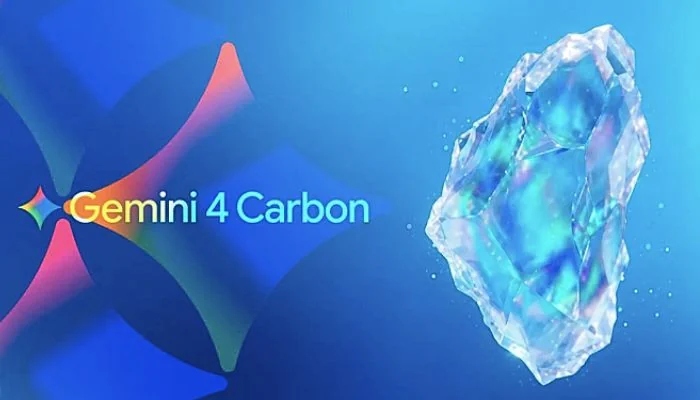
Google has reportedly introduced two new artificial intelligence models, Gemini 4 Carbon and Genie 4, expanding its work in advanced AI systems. According to the supplied report, the models are designed for different applications, including cybersecurity analysis and the creation of simulated digital environments.
The announcement comes amid growing competition among AI developers to build systems capable of performing increasingly specialised tasks. The report states that Google introduced other AI models approximately two weeks earlier, with Gemini 4 Carbon representing another step in the company’s reported AI development efforts.
According to the information provided, Gemini 4 Carbon has been designed primarily for cybersecurity professionals. Its intended capabilities include identifying vulnerabilities in computer systems and helping specialists address potential security weaknesses. Such tools could support software testing, vulnerability assessments and defensive security research.
The report also claims that Gemini 4 Carbon outperformed Gemini 4 Argon and OpenAI’s GPT-6 Astra in benchmark testing. However, the significance of these comparisons depends on the benchmarks used, the testing conditions and whether the results have been independently verified. Detailed technical evidence would be necessary to establish the models’ relative performance reliably.
Google’s second reported model, Genie 4, is described as a world model. Unlike conventional chatbots that primarily generate responses based on language inputs, world models aim to represent and simulate environments. These systems can potentially model objects, surroundings and interactions, allowing developers to explore how digital environments might behave under different conditions.
Genie 4 is also reported to include audio capabilities. Developers would be able to incorporate background sounds and dialogue into AI-generated worlds, potentially making simulated environments more immersive. Such features could support video game development, interactive media, robotics research and other applications involving virtual environments.