

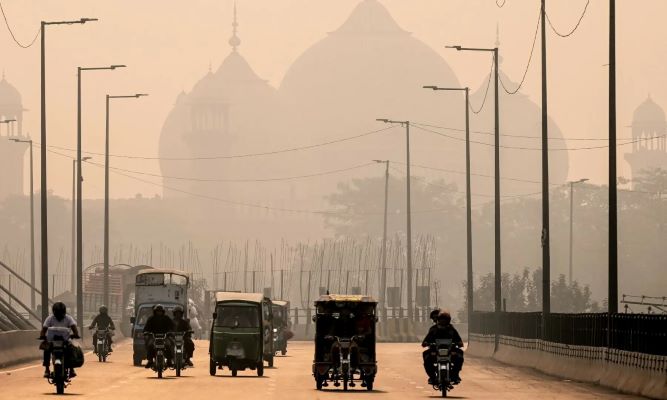
Lahore pollution levels rose sharply on Friday, placing the city at the top of IQAir’s global ranking of the most polluted major cities. Lahore recorded an air quality index (AQI) of 167, ahead of Dhaka at 164 and Cairo at 158. The reading placed the city in the unhealthy category.
Punjab authorities later recorded Lahore’s AQI at 236, attributing the buildup of pollutants partly to weak winds and lower temperatures. Officials said winds were moving from the southeast at around five to six kilometres per hour during the morning. Faster winds later in the day could help disperse pollutants.
Air quality varied significantly across Lahore’s monitored areas. The Punjab Environment Protection Agency recorded an AQI of 500 on Multan Road at 6am. Readings were 345 at Punjab University, 292 in Shahdara and 227 in Gulberg III. By 8am, Punjab University recorded 385, while Multan Road dropped to 91.
IQAir updates its rankings hourly, so pollution levels and city positions can change during the day. The changing readings showed how weather conditions and wind movement affected Lahore pollution levels. Authorities intensified operations in areas recording high AQI readings across the provincial capital.
Smog guns, water bowsers and sprayers were deployed at several pollution hotspots to control emissions and road dust. Water sprinkling was carried out around the Ring Road service line, GT Road near UET and Shalimar Town, as well as Burki, DHA and Multan Road. Drone and night teams also monitored pollution sources.
Authorities reported inspections of 319 industrial units, with 15 facilities sealed and one case registered. Teams also inspected 421 brick kilns, demolishing five and sealing eight. A separate operation against substandard plastic covered 267 locations, while 249 barbecue and commercial cooking sites were inspected for smoke emissions.
The government also stepped up measures against crop-residue burning during the harvesting season. Officials said paddy had been mechanically harvested across 724,900 acres, while more than 437,000 notices were issued to farmers. Authorities said enforcement and preventive measures would continue as Lahore pollution remains a recurring concern during cooler months.